
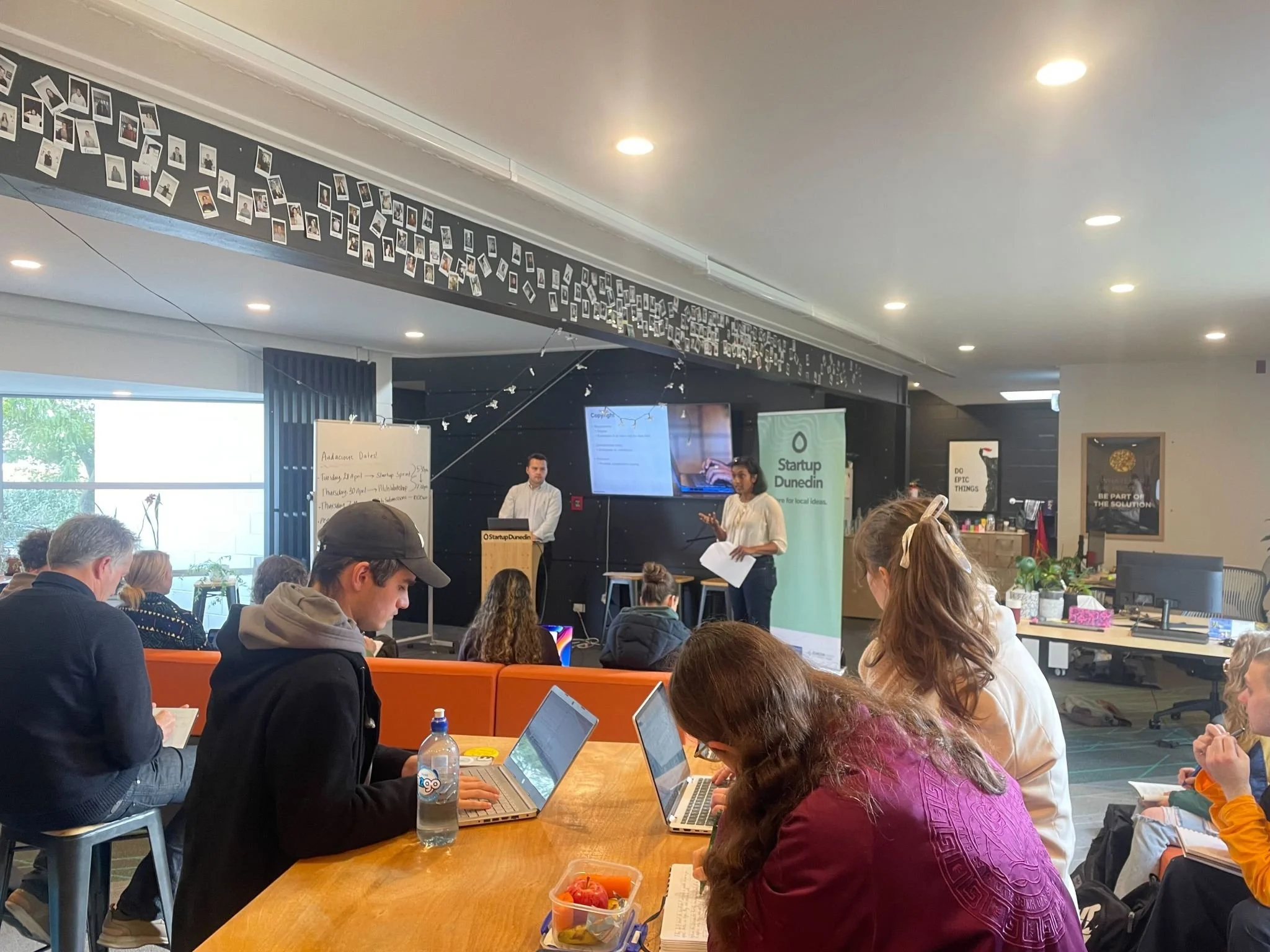
This blog was co-created with Hudson Gavin Martin following a practical in-person session with Anchali Anandanayagam (Partner) and Luiz Buck (Senior Associate). Hudson Gavin Martin is a corporate, commercial, and dispute resolution law firm boasting the largest and most experienced legal team in the country, focused on technology, media, and IP.
Intellectual property (IP) may seem complex, but here we try to provide a general overview of what to consider, so that as a startup you can begin to understand how you can protect your ideas, innovations and creations.
This blog is designed to be an intro to some of the key IP terms and concepts. We encourage you to receive proper legal advice from a friendly lawyer. This blog should not be the only research you do, it’s meant to be a starting point so you can protect your IP early.
What is IP, and why does it matter?
IP is all about the protection of ideas, innovations and creations. This can include the name and logo of your product, the code in your app, and the processes behind your service. Getting clear on what you own and how to protect it is one of the most strategic things you can do as a founder.
IP rights generally fall into two broad categories:
Unregistered rights (for example, confidential information and copyright)
Registered rights (such as trade marks and patents)
Unregistered Rights:
Confidential Information
Confidential information is an often-overlooked IP protection available to startups. Confidential information is information that is proprietary to your business and has a confidential nature, such as your processes, customer lists, pricing strategies, trade secrets or code. If your confidential information is in the hands of third parties who have no restrictions on what they can do with it, it could be detrimental to your business.
For information to qualify for protection, it must:
have a confidential nature about it;
have been shared in confidence; and
cause real harm if used by another party without authorisation.
We recommend that all startups put in place a non-disclosure or confidentiality agreement with anyone to whom they provide confidential information, so you can prevent the unauthorised use or disclosure of that information. Some people will refuse to sign documents, and that's their right. If that happens, you should weigh up the risk of continuing to engage with those people and, if you decide to continue to do so, consider adding a confidentiality note in your email subject line and on any material you share as a lightweight measure.
A word of caution: Be careful about inputting your confidential information into publicly available AI tools. Depending on the nature of those tools and the tool provider’s terms, your information may be used by the tool provider for their own purposes (e.g. training their tools) or disclosed to other users of those tools.
Benefits:
Completely within your control
Free and immediate
Isn’t tied to a territory
Can last indefinitely (depending on the nature of the information and what you agree with the person you are disclosing to)
Limitations:
It doesn't prevent someone else from independently creating the same thing
Copyright
Copyright is automatic and free in New Zealand; no registration is required. Copyright protects original expressions of ideas, such as your website copy, marketing assets, software code, design work and photography. Importantly, it protects the expression of an idea, not the idea itself.
New Zealand is part of the Berne Convention, which means if you have copyright protection here, that protection generally extends to countries that are also party to that convention. However, some countries (including those in the Berne Convention) do have their own specific registration requirements, so it is important to check how you are protected if you're planning on operating internationally.
One thing that catches a lot of founders out is commissioned work. If you pay a contractor or service provider to create something (other than a literary work) for your business (e.g. software), then you generally own the IP in what they produce. However, you should make sure this rule isn’t displaced in any agreement you sign with a contractor or service provider. It’s important to be clear with your contractors and service providers that you own any IP produced as part of the work they do for you.
If you are an employee, you also need to be mindful that anything you create in the course of your employment is owned by your employer under New Zealand copyright law.
Benefits:
Automatic
Free
Long-lasting, for most author-created works, copyright lasts for the life of the author plus 50 years from the end of the calendar year in which they die (but note, there are proposed changes before Parliament to increase the length of copyright in New Zealand)
Limitations:
You will need to be able to prove originality to claim copyright protection (keep records and version histories)
Copyright prevents copying, but not independent creation
Overseas protection may require separate registration
Registered Rights:
Trade marks
A trade-mark is how customers identify you, your name, logo, slogan, colour, or even a sound, think Cadbury's purple, Speights’ branding, or a distinctive tagline. To get protection for your trade marks, it is sensible to apply for registration in each country where you want protection. Your trade mark must be distinctive, not merely descriptive of what you offer.
There are 45 classes of goods and services to register under, and you choose which are relevant to your business. Once registered, a trade mark prevents others from using the same or a similar mark in the same or similar categories from the date of registration.
The process of registration can take several months, so this should be factored into your planning, especially if you're moving toward a specific launch date. Once registered, a trade mark lasts for 10 years and is renewable without limit if you have been using the mark. Note, a trade mark may be revoked if it is not used for a continuous three-year period, so you should use the marks that you register.
A trade mark cannot be registered if it is likely to offend a significant section of the community, including Māori. This means there are different rules for registering trade marks that include Māori signs (such as Māori words or imagery). The Māori Trade Marks Advisory Committee reviews trade marks that are, or appear to be, derivative of a Māori sign and considers whether the mark is likely to offend Māori.
Benefits:
Indefinite protection with periodic renewal fees
Relatively affordable to apply for and maintain
Limitations:
It's territorial; you'll need to register separately in each region you operate in
Patents
A patent grants you a monopoly on a new invention. Patents give you an exclusive right to make, use, sell, or import the invention.
To qualify for registration, your invention must be useful, genuinely new, and not already publicly disclosed. Patents can take some time to be registered and can be costly. While the application fee may not be significant, depending on the country you want to register in, the associated legal fees to prepare the application might be substantial.
Benefits:
Monopoly protection over your invention for the length of the patent
Limitations:
They can be costly to register
Take significant time to obtain
Are territorial; meaning you will need to register in each country you want to operate in
Are time-limited; in New Zealand, patents can only last for 20 years from the date they were filed
For most early-stage startups, patents are something to plan for strategically rather than rush into. Make sure the investment is proportionate to the stage you’re at and how defensible the invention actually is.
Key takeaways for founders
A few things you can do right now:
Write things down and keep good records of your ideas.
Clarify IP ownership in every contract, whether you're engaging a developer, designer, contractor or service provider. Keep records so you can prove originality if you ever need to.
Think about registering a trade mark early if your brand is central to your business, and start the process before you need it.
Be careful if you are using AI tools; don't input proprietary work into external platforms without checking the terms and conditions first. If you are in any doubt, speak to a specialist lawyer.
Whether you are just starting up and wanting to protect your IP, or looking to get outside investment or exit your business, Hudson Gavin Martin can help. You can contact Anchali or Luiz using the details below.
Contact:
Anchali Anandanayagam | Partner
E: anchali.anandanayagam@hgmlegal.com
T: 09 220 5616
Luiz Buck | Senior Associate
T: 09 220 5624